Industry news
Luxeed V9 Debuts World-First Electromagnetic Thermal Control Die-Casting Technology
On April 22, the Harmony Intelligent Mobility Spring New Product Launch Event was grandly held at the Guangzhou Greater Bay Area Cultural and Sports Center. At the event, Luxeed Auto officially announced that the integrated die-cast rear floor of its first 9-series flagship MPV, the Luxeed V9, adopts the world's first electromagnetic thermal control die-casting technology. This marks the first time that a large-scale integrated die-cast rear floor has been mass-produced using a die-casting cell with a clamping force of less than 6,000 tons.
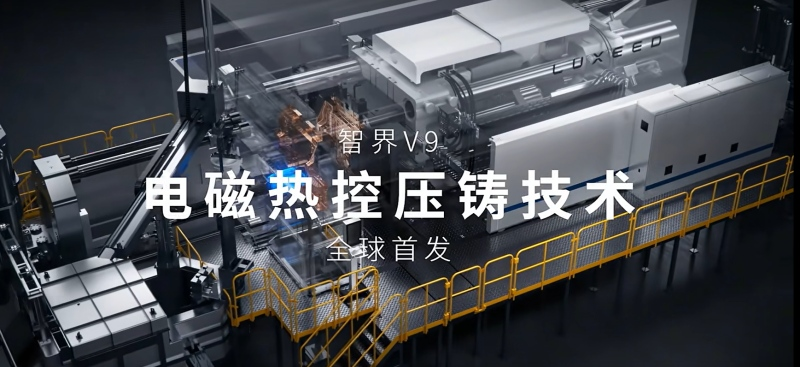
This technological breakthrough signifies that automotive die-casting has moved away from the traditional path of "tonnage dependence" and entered a new era of precise electromagnetic-thermodynamic intelligent manufacturing.
Technology Deconstruction: Four-Stage Process Reinvents the Core Logic of Die-Casting
The electromagnetic thermal control die-casting technology equipped on the Luxeed V9 is centered on the synergy of "electromagnetic field regulation + nano thermal control layer". Through precise control of four key stages, it achieves an innovative upgrade of the aluminum liquid forming process, overturning the conventional die-casting model of "winning by force".
· l Filling (Injection) Stage: A strong electromagnetic field precisely acts on the aluminum liquid, significantly reducing its surface tension and flow viscosity. This transforms the metal liquid from a "tight and stagnant state" to a "uniform and smooth flow state", laying a solid foundation for subsequent efficient and uniform mold filling.
· l Mold Filling Stage: The nano thermal control layer on the inner wall of the mold automatically switches to thermal insulation mode, precisely maintaining the temperature consistency of the aluminum liquid during the filling process, thus solving common defects in traditional die-casting such as uneven filling, cold shuts, and misruns.
· l Cooling Stage: Dynamic electromagnetic field regulation, combined with the nano layer instantly switching to heat conduction mode, enables rapid and uniform heat dissipation of the aluminum liquid, effectively avoiding internal defects like local shrinkage porosity and gas porosity, and enhancing the density of the die-cast part.
· l Solidification (Forming) Stage: The aluminum liquid rapidly solidifies under a precisely controlled temperature environment, forming a dense structure with both high density and excellent mechanical properties, successfully breaking through the technical bottleneck of forming large complex structural components.
Performance Validation: Bidirectional Improvement in Strength and Lightweighting
The implementation of electromagnetic thermal control die-casting technology brings tangible and significant performance improvements to the Luxeed V9, providing core technical support for body safety and lightweight design.
· l Significant Strength Enhancement: The yield strength of this integrated die-cast part is increased by 55% compared to traditional die-cast products. The mechanical properties at 32 key points remain highly consistent, perfectly addressing the industry pain point of uneven mechanical properties in conventional die-cast parts.
· l Outstanding Lightweighting Achievement: The overall weight of the die-cast part is reduced by 15.5%. While ensuring body rigidity and handling flexibility, it effectively reduces the vehicle's energy consumption and further improves driving range.
· l Structural Integration & Optimization: The original 78 individual components of core parts such as the rear floor are integrated into a single formed structure. The number of weld spots is reduced by 760, greatly improving body structural stability and assembly efficiency while reducing production losses.
Industry Outlook: Ushering in a New Era of Precision-Controlled Automotive Die-Casting
Industry experts state that the mass production implementation of Luxeed V9's electromagnetic thermal control die-casting technology signifies that integrated die-casting has officially entered the "era of precision control". By combining "electromagnetic flow control + nano thermal regulation", this technology provides a brand-new solution for the development and production of large complex structural castings, and is expected to drive the entire automotive die-casting industry away from the homogenization trap of tonnage competition, focusing instead on process innovation and performance enhancement.
Source: Diecasting Weekly
About CHINA DIECASTING & CHINA NONFERROUS 2026
CHINA DIECASTING & CHINA NONFERROUS expo 2026, will be held from July 15 to 17, 2026 at Shanghai New International Expo Centre (Halls N1–N5). As Asia's largest specialized exhibition for die casting and nonferrous foundry, this edition, under the theme "Twin Engines: Al & Mg, A Lightweight Future," is expected to span 52,000 square meters, attract over 600 exhibitors, and welcome 28,000 professional visitors. Colleagues from around the world are warmly invited to visit and exchange insights.
The global die casting industry is undergoing several major transformations: the scaling and industrialization of large megacasting, breakthroughs in rheocasting technologies, and the expanding potential of die casting beyond new energy vehicles - into fields such as Two-Wheelers (Emerging Trend: Replacing Aluminum with Magnesium), humanoid robot, energy storage, photovoltaics, and aerospace. As a barometer of the Asian market, the event will showcase technological advancements, product applications, and integrated solutions across these three key tracks.
This technological breakthrough signifies that automotive die-casting has moved away from the traditional path of "tonnage dependence" and entered a new era of precise electromagnetic-thermodynamic intelligent manufacturing.
Technology Deconstruction: Four-Stage Process Reinvents the Core Logic of Die-Casting
The electromagnetic thermal control die-casting technology equipped on the Luxeed V9 is centered on the synergy of "electromagnetic field regulation + nano thermal control layer". Through precise control of four key stages, it achieves an innovative upgrade of the aluminum liquid forming process, overturning the conventional die-casting model of "winning by force".
· l Filling (Injection) Stage: A strong electromagnetic field precisely acts on the aluminum liquid, significantly reducing its surface tension and flow viscosity. This transforms the metal liquid from a "tight and stagnant state" to a "uniform and smooth flow state", laying a solid foundation for subsequent efficient and uniform mold filling.
· l Mold Filling Stage: The nano thermal control layer on the inner wall of the mold automatically switches to thermal insulation mode, precisely maintaining the temperature consistency of the aluminum liquid during the filling process, thus solving common defects in traditional die-casting such as uneven filling, cold shuts, and misruns.
· l Cooling Stage: Dynamic electromagnetic field regulation, combined with the nano layer instantly switching to heat conduction mode, enables rapid and uniform heat dissipation of the aluminum liquid, effectively avoiding internal defects like local shrinkage porosity and gas porosity, and enhancing the density of the die-cast part.
· l Solidification (Forming) Stage: The aluminum liquid rapidly solidifies under a precisely controlled temperature environment, forming a dense structure with both high density and excellent mechanical properties, successfully breaking through the technical bottleneck of forming large complex structural components.
Performance Validation: Bidirectional Improvement in Strength and Lightweighting
The implementation of electromagnetic thermal control die-casting technology brings tangible and significant performance improvements to the Luxeed V9, providing core technical support for body safety and lightweight design.
· l Significant Strength Enhancement: The yield strength of this integrated die-cast part is increased by 55% compared to traditional die-cast products. The mechanical properties at 32 key points remain highly consistent, perfectly addressing the industry pain point of uneven mechanical properties in conventional die-cast parts.
· l Outstanding Lightweighting Achievement: The overall weight of the die-cast part is reduced by 15.5%. While ensuring body rigidity and handling flexibility, it effectively reduces the vehicle's energy consumption and further improves driving range.
· l Structural Integration & Optimization: The original 78 individual components of core parts such as the rear floor are integrated into a single formed structure. The number of weld spots is reduced by 760, greatly improving body structural stability and assembly efficiency while reducing production losses.
Industry Outlook: Ushering in a New Era of Precision-Controlled Automotive Die-Casting
Industry experts state that the mass production implementation of Luxeed V9's electromagnetic thermal control die-casting technology signifies that integrated die-casting has officially entered the "era of precision control". By combining "electromagnetic flow control + nano thermal regulation", this technology provides a brand-new solution for the development and production of large complex structural castings, and is expected to drive the entire automotive die-casting industry away from the homogenization trap of tonnage competition, focusing instead on process innovation and performance enhancement.
Source: Diecasting Weekly
About CHINA DIECASTING & CHINA NONFERROUS 2026
CHINA DIECASTING & CHINA NONFERROUS expo 2026, will be held from July 15 to 17, 2026 at Shanghai New International Expo Centre (Halls N1–N5). As Asia's largest specialized exhibition for die casting and nonferrous foundry, this edition, under the theme "Twin Engines: Al & Mg, A Lightweight Future," is expected to span 52,000 square meters, attract over 600 exhibitors, and welcome 28,000 professional visitors. Colleagues from around the world are warmly invited to visit and exchange insights.
The global die casting industry is undergoing several major transformations: the scaling and industrialization of large megacasting, breakthroughs in rheocasting technologies, and the expanding potential of die casting beyond new energy vehicles - into fields such as Two-Wheelers (Emerging Trend: Replacing Aluminum with Magnesium), humanoid robot, energy storage, photovoltaics, and aerospace. As a barometer of the Asian market, the event will showcase technological advancements, product applications, and integrated solutions across these three key tracks.