Press release
OEMs Care More About This Drive Component Than You Might Imagine
What does the e-drive industry care about most?
Looking at the agenda of any industry forum in recent years, the answers seem to converge on: higher speed, higher voltage, higher power density, lower cost, and so on. At one e-drive symposium in 2026, a leading company had already set 30,000 rpm as an engineering target for ultra-high-speed e-drives. The industry's spotlight is fixed on these "visible metrics"—motor speed breakthroughs, SiC adoption, multi-in-one integration, and NVH optimization. And rightly so—these are the core capabilities of an e-drive system that directly impact vehicle competitiveness.
But there is one issue that rarely makes it onto e-drive engineers' priority lists.
The housing: an easily underestimated "system constraint"
As e-drive systems move from 20,000 rpm to 25,000–30,000 rpm, rotor centrifugal forces, bearing friction losses, and gear meshing characteristics are all pushed to their limits. Yet all of these ultimately rest on the same foundation—the housing's stiffness, precision, heat dissipation capability, and lightweighting performance.
On thermal management: heat from stator core losses, copper losses in the motor, and switching losses in the controller must ultimately be dissipated through the housing. The cross-sectional area and routing of cooling channels, and their conformity to heat sources—these housing-level design parameters directly determine whether the system needs to derate under high-load conditions.
On NVH: the whine issue in high-speed e-drives often has little to do with the electromagnetic design, but rather occurs when the housing's modal distribution happens to be excited by a certain harmonic order. How ribs are arranged, how wall thickness transitions, whether bearing seat stiffness is sufficient—these details set the upper limit of vehicle sound quality.
On integration: the challenge of multi-in-one e-drives is no longer "whether they can fit," but "whether thermal insulation, sealing, fault isolation, and serviceability can all be satisfied at once after integration." The housing is precisely the interface where all these constraints converge.
"Why are OEMs more concerned than the e-drive industry itself?"
While the e-drive industry is still focused on "speed breakthroughs and cost control," OEMs have begun systematically tracking housing technologies.
Policy pressure: Lightweighting has shifted from a "nice-to-have" to a "must-have." Some European countries have incorporated vehicle weight into subsidy eligibility criteria, and Japan plans to adjust EV weight taxes starting in 2028.
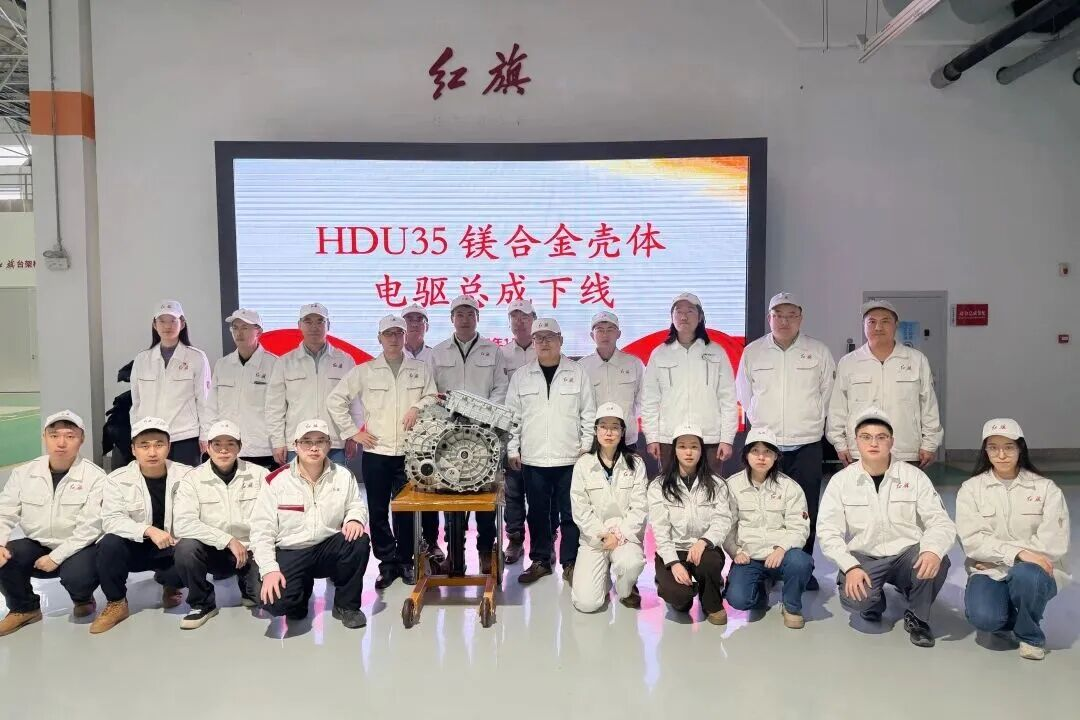
Range anxiety: Every component is being pushed to shed weight. How much weight reduction potential does an e-drive housing offer? Taking the Hongqi HDU35 hybrid e-drive system as an example, switching to a magnesium alloy housing saves 10 kg per unit.
Performance bottlenecks: The housing's limits directly cap the system's limits. If the housing design fails to meet thermal or stiffness requirements, no matter how efficient the motor design, it will be forced to derate under high loads.
OEMs are now directly partnering with material suppliers, casting foundries, and research institutions to lead the development of critical housings.
Hongqi magnesium alloy e-drive housing — FAW, in collaboration with FAW Foundry and others, developed a magnesium alloy e-drive housing that sheds 10 kg compared to aluminum alloy.
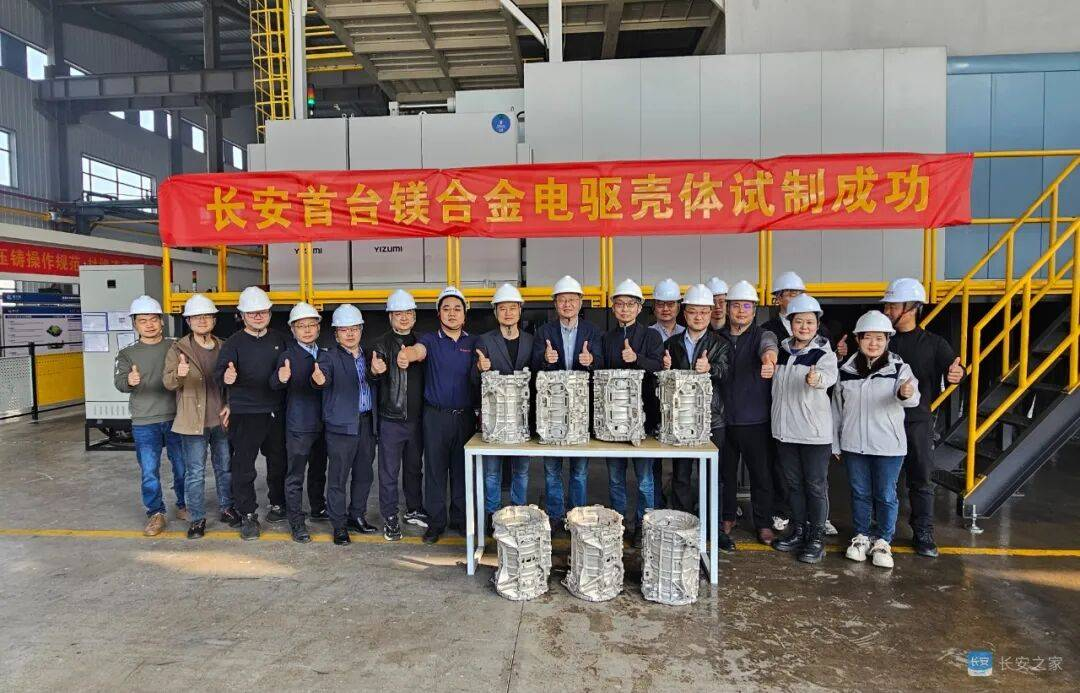
Changan Automobile magnesium alloy e-drive housing — In partnership with Shanghai Jiao Tong University, Chenzhi Lightweight, and Fengyang LS, Changan successfully trial-produced an ultra-large magnesium alloy e-drive housing with a 23% weight reduction.
NIO heat-treatment-free aluminum alloy e-drive housing — Collaborating with Shanghai Jiao Tong University and Fengyang LS, NIO developed NIO-ZL004 ultra-high-strength die-cast aluminum alloy, now mass-produced and applied to the e-drive housing of NIO's flagship ET9 model.
BYD's intensive housing patent filings — BYD has consecutively obtained multiple e-drive housing-related patents in 2024–2025.
When OEMs begin defining housing materials themselves, leading joint R&D efforts, and filing their own patents—how should traditional e-drive system suppliers respond?
By understanding the technical weight of housings earlier and more deeply than OEMs, and translating that into system-level integration capabilities.
This July in Shanghai, at Asia's largest die casting and non-ferrous casting exhibition, you will see core aluminum and magnesium alloy casting solutions for passenger and commercial vehicle powertrain systems:
New energy e-drive systems: motor housings, motor front/rear end covers, bearing seats, junction boxes, motor water jackets; within the electronic control system—motor controller housings, inverter housings, DC/DC converter housings, on-board charger (OBC) housings, high-voltage distribution unit housings; within the reducer system—reducer housings, differential housings, axle shaft sleeves; and multi-in-one integrated housings.
Conventional ICE engine systems: cylinder blocks, cylinder heads, crankcases, oil pans, flywheel housings, timing covers, intake manifolds, engine mounting brackets, as well as pump and valve housings including oil pump housings, water pump housings, oil filter housings, and thermostat housings.
Transmission and driveline systems: transmission cases, transmission covers, valve plates, clutch housings and end covers, torque converter housings, transfer case housings, power take-off housings, differential housings, and more.
Other housings in commercial vehicle powertrains.
This July in Shanghai—a technical event worth attending!
July 15–17, 2026, CHINA DIECASTING & CHINA NONFERROUS will be held at the Shanghai New International Expo Centre (Halls N1–N5). The exhibition is expected to span 52,000 sqm, feature 650+ exhibitors, and attract 28,000+ professional visitors from core application and manufacturing sectors including OEMs, Tier 1 suppliers, casting enterprises, and equipment and material suppliers.
Under the theme "Twin Engines: Al & Mg, A Lightweight Future," the exhibition focuses on the development of light metal non-ferrous alloy casting (aluminum, magnesium, zinc, etc.)—from materials and processes to applications. It will feature dedicated zones including the Magnesium Alloy High Pressure Die Casting / Semi Solid Forming Industry Chain Display Area, the TOP Casting Producers Area, and the Squeeze Casting Pavilion, along with 7 technology tour routes led by experts covering magnesium alloy forming, mega casting, TOP castings, post processing, and more.
Housing design is not just about "enclosing the system." When magnesium alloy e-drive housings begin volume production for vehicles, when heat-treatment free materials can be used straight out of the die casting machine, when OEMs start collaborating directly with foundries to develop housings—these changes are happening right now on the front lines of the die casting industry...
Your customers, peers, and suppliers are all deeply engaged in this industry-wide event.
Automotive OEMs: Audi, BMW, Hyundai, Honda, BYD, Volvo, Dongfeng, PATAC, Toyota, Ford, Daye Motor, Hengchi, Human Horizons, Geely, ZEEKR, Chery Jaguar Land Rover, Voyah, Renault, Li Auto, Leapmotor, Mercedes Benz, Seres, Volkswagen, JIDU, SAIC Motor, NIO, General Motors, Xiaomi, XPENG, XPENG AeroHT, GWM, Changan Automobile, IM Motors, FAW, SINOTRUK, Sokon, and more.
Drive system suppliers: Denso, Nidec, Autoliv, BENTELER, Honda Auto Parts, BorgWarner, Bosch, ZF, Continental Automotive, Maxion Wheels, thyssenkrupp Presta, NSK, Zhejiang Founder Motor, Feilong Auto Components, Honeycomb Electric Drive, Fudi Power, Yida Electric Drive, Gangyang Group, Fuji Electric, Toyota Engine, Gestamp, Nanyang Motor, Huayu Powertrain, Huayu Kolbenschmidt Pistons, Huayu Magna Electric Drive Systems, Huayu Pierburg, Sanden HASCO Automotive Air Conditioning, Inovance Technology, Huizhong New Energy, Honeywell, Sitong Wheel, Caterpillar, Cummins, Comau, United Automotive Electronic Systems, Rockwell Automation, Magna, Nexteer Automotive, Shenglong Automotive Power, CATL, Hyundai WIA, Fast Gear, Shanghai Edrive, Shanghai Automotive Gear Works, Schaeffler, BYD Lithium Battery, Hanyang Precision Electronics, Luxshare Technology, Delta Electronics, Weichai Diesel, Weifu Electric Drive, Xingqu Power, Siemens, Toyota Engine, Eaton China, Changan Mazda, Wanliyang, Changan Chassis Systems, CRRC Times Electric, and more.
This July in Shanghai, all professionals interested in e drive housing technology are welcome to come and see for yourselves: What are your customers, your peers, and your suppliers doing in this field? What is happening in this industry that is so closely tied to mobility? And what is about to happen?
*Some contents and images are sourced from: FAW R&D Center, Changan Automobile, and NIO public information; China National Intellectual Property Administration (CNIPA).
Looking at the agenda of any industry forum in recent years, the answers seem to converge on: higher speed, higher voltage, higher power density, lower cost, and so on. At one e-drive symposium in 2026, a leading company had already set 30,000 rpm as an engineering target for ultra-high-speed e-drives. The industry's spotlight is fixed on these "visible metrics"—motor speed breakthroughs, SiC adoption, multi-in-one integration, and NVH optimization. And rightly so—these are the core capabilities of an e-drive system that directly impact vehicle competitiveness.
But there is one issue that rarely makes it onto e-drive engineers' priority lists.
The housing: an easily underestimated "system constraint"
As e-drive systems move from 20,000 rpm to 25,000–30,000 rpm, rotor centrifugal forces, bearing friction losses, and gear meshing characteristics are all pushed to their limits. Yet all of these ultimately rest on the same foundation—the housing's stiffness, precision, heat dissipation capability, and lightweighting performance.
On thermal management: heat from stator core losses, copper losses in the motor, and switching losses in the controller must ultimately be dissipated through the housing. The cross-sectional area and routing of cooling channels, and their conformity to heat sources—these housing-level design parameters directly determine whether the system needs to derate under high-load conditions.
On NVH: the whine issue in high-speed e-drives often has little to do with the electromagnetic design, but rather occurs when the housing's modal distribution happens to be excited by a certain harmonic order. How ribs are arranged, how wall thickness transitions, whether bearing seat stiffness is sufficient—these details set the upper limit of vehicle sound quality.
On integration: the challenge of multi-in-one e-drives is no longer "whether they can fit," but "whether thermal insulation, sealing, fault isolation, and serviceability can all be satisfied at once after integration." The housing is precisely the interface where all these constraints converge.
"Why are OEMs more concerned than the e-drive industry itself?"
While the e-drive industry is still focused on "speed breakthroughs and cost control," OEMs have begun systematically tracking housing technologies.
Policy pressure: Lightweighting has shifted from a "nice-to-have" to a "must-have." Some European countries have incorporated vehicle weight into subsidy eligibility criteria, and Japan plans to adjust EV weight taxes starting in 2028.
Range anxiety: Every component is being pushed to shed weight. How much weight reduction potential does an e-drive housing offer? Taking the Hongqi HDU35 hybrid e-drive system as an example, switching to a magnesium alloy housing saves 10 kg per unit.
Performance bottlenecks: The housing's limits directly cap the system's limits. If the housing design fails to meet thermal or stiffness requirements, no matter how efficient the motor design, it will be forced to derate under high loads.
OEMs are now directly partnering with material suppliers, casting foundries, and research institutions to lead the development of critical housings.
Hongqi magnesium alloy e-drive housing — FAW, in collaboration with FAW Foundry and others, developed a magnesium alloy e-drive housing that sheds 10 kg compared to aluminum alloy.
Changan Automobile magnesium alloy e-drive housing — In partnership with Shanghai Jiao Tong University, Chenzhi Lightweight, and Fengyang LS, Changan successfully trial-produced an ultra-large magnesium alloy e-drive housing with a 23% weight reduction.
NIO heat-treatment-free aluminum alloy e-drive housing — Collaborating with Shanghai Jiao Tong University and Fengyang LS, NIO developed NIO-ZL004 ultra-high-strength die-cast aluminum alloy, now mass-produced and applied to the e-drive housing of NIO's flagship ET9 model.
BYD's intensive housing patent filings — BYD has consecutively obtained multiple e-drive housing-related patents in 2024–2025.
When OEMs begin defining housing materials themselves, leading joint R&D efforts, and filing their own patents—how should traditional e-drive system suppliers respond?
By understanding the technical weight of housings earlier and more deeply than OEMs, and translating that into system-level integration capabilities.
This July in Shanghai, at Asia's largest die casting and non-ferrous casting exhibition, you will see core aluminum and magnesium alloy casting solutions for passenger and commercial vehicle powertrain systems:
New energy e-drive systems: motor housings, motor front/rear end covers, bearing seats, junction boxes, motor water jackets; within the electronic control system—motor controller housings, inverter housings, DC/DC converter housings, on-board charger (OBC) housings, high-voltage distribution unit housings; within the reducer system—reducer housings, differential housings, axle shaft sleeves; and multi-in-one integrated housings.
Conventional ICE engine systems: cylinder blocks, cylinder heads, crankcases, oil pans, flywheel housings, timing covers, intake manifolds, engine mounting brackets, as well as pump and valve housings including oil pump housings, water pump housings, oil filter housings, and thermostat housings.
Transmission and driveline systems: transmission cases, transmission covers, valve plates, clutch housings and end covers, torque converter housings, transfer case housings, power take-off housings, differential housings, and more.
Other housings in commercial vehicle powertrains.
This July in Shanghai—a technical event worth attending!
July 15–17, 2026, CHINA DIECASTING & CHINA NONFERROUS will be held at the Shanghai New International Expo Centre (Halls N1–N5). The exhibition is expected to span 52,000 sqm, feature 650+ exhibitors, and attract 28,000+ professional visitors from core application and manufacturing sectors including OEMs, Tier 1 suppliers, casting enterprises, and equipment and material suppliers.
Under the theme "Twin Engines: Al & Mg, A Lightweight Future," the exhibition focuses on the development of light metal non-ferrous alloy casting (aluminum, magnesium, zinc, etc.)—from materials and processes to applications. It will feature dedicated zones including the Magnesium Alloy High Pressure Die Casting / Semi Solid Forming Industry Chain Display Area, the TOP Casting Producers Area, and the Squeeze Casting Pavilion, along with 7 technology tour routes led by experts covering magnesium alloy forming, mega casting, TOP castings, post processing, and more.
Housing design is not just about "enclosing the system." When magnesium alloy e-drive housings begin volume production for vehicles, when heat-treatment free materials can be used straight out of the die casting machine, when OEMs start collaborating directly with foundries to develop housings—these changes are happening right now on the front lines of the die casting industry...
Your customers, peers, and suppliers are all deeply engaged in this industry-wide event.
Automotive OEMs: Audi, BMW, Hyundai, Honda, BYD, Volvo, Dongfeng, PATAC, Toyota, Ford, Daye Motor, Hengchi, Human Horizons, Geely, ZEEKR, Chery Jaguar Land Rover, Voyah, Renault, Li Auto, Leapmotor, Mercedes Benz, Seres, Volkswagen, JIDU, SAIC Motor, NIO, General Motors, Xiaomi, XPENG, XPENG AeroHT, GWM, Changan Automobile, IM Motors, FAW, SINOTRUK, Sokon, and more.
Drive system suppliers: Denso, Nidec, Autoliv, BENTELER, Honda Auto Parts, BorgWarner, Bosch, ZF, Continental Automotive, Maxion Wheels, thyssenkrupp Presta, NSK, Zhejiang Founder Motor, Feilong Auto Components, Honeycomb Electric Drive, Fudi Power, Yida Electric Drive, Gangyang Group, Fuji Electric, Toyota Engine, Gestamp, Nanyang Motor, Huayu Powertrain, Huayu Kolbenschmidt Pistons, Huayu Magna Electric Drive Systems, Huayu Pierburg, Sanden HASCO Automotive Air Conditioning, Inovance Technology, Huizhong New Energy, Honeywell, Sitong Wheel, Caterpillar, Cummins, Comau, United Automotive Electronic Systems, Rockwell Automation, Magna, Nexteer Automotive, Shenglong Automotive Power, CATL, Hyundai WIA, Fast Gear, Shanghai Edrive, Shanghai Automotive Gear Works, Schaeffler, BYD Lithium Battery, Hanyang Precision Electronics, Luxshare Technology, Delta Electronics, Weichai Diesel, Weifu Electric Drive, Xingqu Power, Siemens, Toyota Engine, Eaton China, Changan Mazda, Wanliyang, Changan Chassis Systems, CRRC Times Electric, and more.
This July in Shanghai, all professionals interested in e drive housing technology are welcome to come and see for yourselves: What are your customers, your peers, and your suppliers doing in this field? What is happening in this industry that is so closely tied to mobility? And what is about to happen?
*Some contents and images are sourced from: FAW R&D Center, Changan Automobile, and NIO public information; China National Intellectual Property Administration (CNIPA).