Press release
Additive Manufacturing Expands Its Role in Die Casting and Nonferrous Foundry
The continued advancement of the automotive and aerospace industries is creating strong momentum for the global die casting and nonferrous foundry sectors. Breakthroughs in lightweight alloy forming technologies are accelerating the adoption of lightweight solutions across a growing range of applications. While aluminum alloys continue to expand their applications and market penetration, magnesium alloys are rapidly emerging as a key growth driver, forming the industry's new “dual-engine” development model.
Against the backdrop of new energy vehicles, megacasting technologies, and the increasing adoption of magnesium alloys, manufacturers are placing greater demands on mold efficiency, thermal management, and structural optimization. As a result, additive manufacturing and 3D printing technologies are becoming increasingly integrated into die casting production, supporting applications such as conformal cooling inserts, mold components, repair solutions, and rapid prototyping.
Research institutions such as the Shenyang Research Institute of Foundry (SRIF) have combined additive manufacturing with rapid casting technologies to enable integrated mold and core production, lower development costs, and near-net-shape manufacturing of highly complex castings.
Conformal cooling channels produced through Selective Laser Melting (SLM) improve cooling efficiency, shorten cycle times, and enhance overall production performance. At the same time, additive manufacturing enables the production of complex mold inserts that cannot be achieved through conventional machining.
Industry collaborations involving Fraunhofer ILT, MacLean-Fogg, and Toyota have demonstrated that additively manufactured mold inserts with near-contour cooling channels can significantly reduce thermal loads and extend mold service life by up to four times compared with conventional H13 tooling.
Laser cladding technologies are also increasingly used to repair worn die casting molds, shot sleeves, and other critical components, improving repair efficiency while reducing downtime and replacement costs.
This capability complements conventional casting processes by establishing a highly efficient development model that combines “additive prototyping and casting mass production,” helping manufacturers shorten development cycles and reduce overall project costs.
Featured participants included: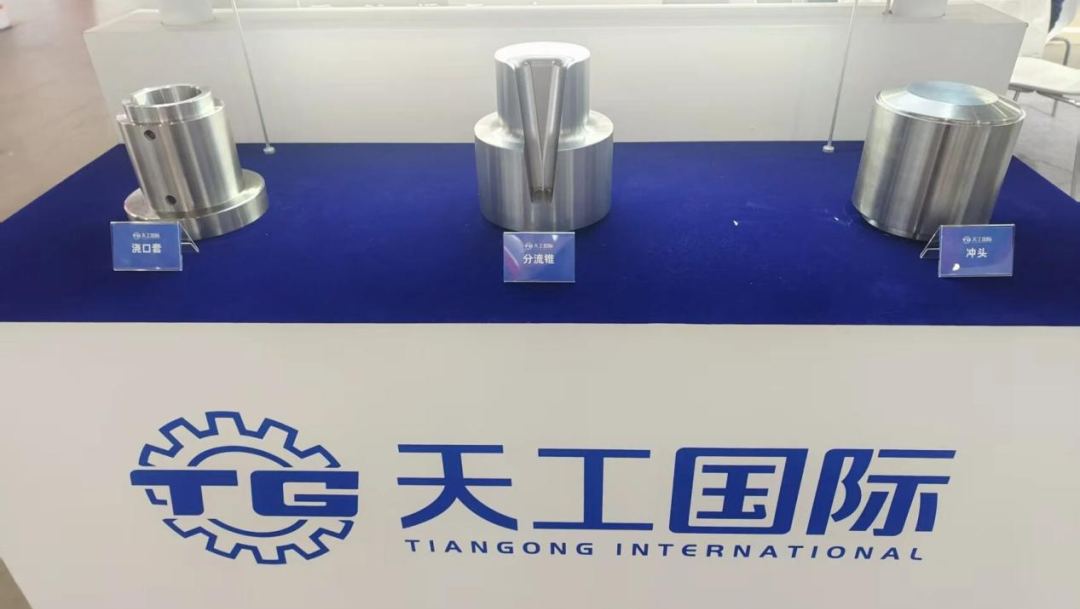

Against the backdrop of new energy vehicles, megacasting technologies, and the increasing adoption of magnesium alloys, manufacturers are placing greater demands on mold efficiency, thermal management, and structural optimization. As a result, additive manufacturing and 3D printing technologies are becoming increasingly integrated into die casting production, supporting applications such as conformal cooling inserts, mold components, repair solutions, and rapid prototyping.
Three Key Applications of Additive Manufacturing in Nonferrous Casting
1 Process Innovation Before Casting
In investment casting and sand casting, additive manufacturing is transforming traditional tooling methods. Direct production of wax patterns, sand molds, sand cores, and ceramic cores through 3D printing significantly reduces lead times while enabling geometries that are difficult or impossible to achieve using conventional tooling.Research institutions such as the Shenyang Research Institute of Foundry (SRIF) have combined additive manufacturing with rapid casting technologies to enable integrated mold and core production, lower development costs, and near-net-shape manufacturing of highly complex castings.
2 Mold Upgrading and Repair
Mold manufacturing and maintenance represent one of the most mature application areas for additive manufacturing within the casting industry.Conformal cooling channels produced through Selective Laser Melting (SLM) improve cooling efficiency, shorten cycle times, and enhance overall production performance. At the same time, additive manufacturing enables the production of complex mold inserts that cannot be achieved through conventional machining.
Industry collaborations involving Fraunhofer ILT, MacLean-Fogg, and Toyota have demonstrated that additively manufactured mold inserts with near-contour cooling channels can significantly reduce thermal loads and extend mold service life by up to four times compared with conventional H13 tooling.
Laser cladding technologies are also increasingly used to repair worn die casting molds, shot sleeves, and other critical components, improving repair efficiency while reducing downtime and replacement costs.
3 Rapid Prototyping and Low-Volume Production
For product development projects involving complex metal components, additive manufacturing offers a tooling-free production route that enables rapid design validation and faster iteration.This capability complements conventional casting processes by establishing a highly efficient development model that combines “additive prototyping and casting mass production,” helping manufacturers shorten development cycles and reduce overall project costs.
Industry Leaders Showcase Additive Solutions
At CHINA DIECASTING & CHINA NONFERROUS 2025, leading additive manufacturing companies, research institutes, and universities demonstrated a wide range of solutions tailored to die casting and nonferrous foundry applications.Featured participants included:
- Tiangong International, showcasing integrated die casting mold material solutions and TFME23A metal powders for mold 3D printing.
- BÖHLER Special Steel (Shanghai), presenting conformal cooling gating sleeves and spreader cone solutions.
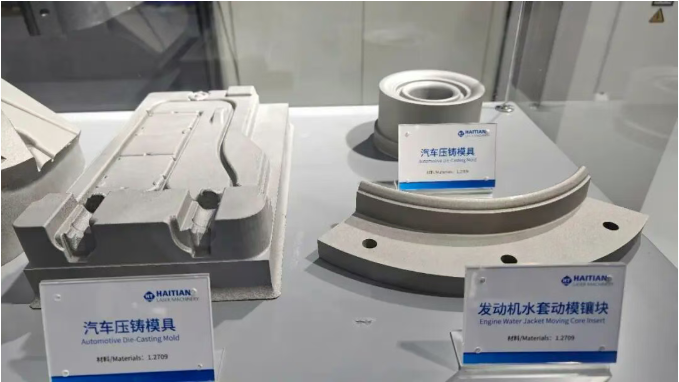
- Haitian Additive Manufacturing, demonstrating large-scale metal 3D printing for automotive die casting molds.
- LAMOTEK, showcasing 3D-printed mold inserts for megacasting applications exceeding 9,000 tons.
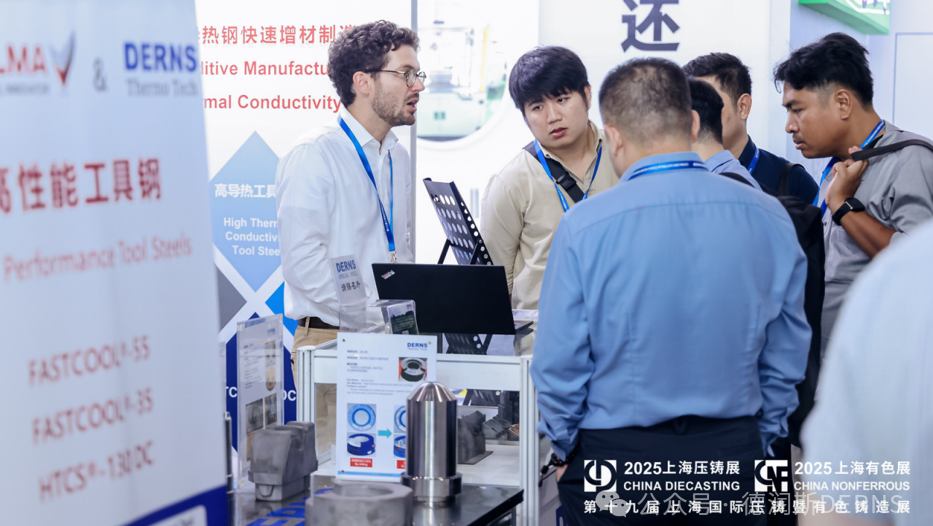
- DERNS Alloy Technology, featuring HTCS® and FASTCOOL® high thermal conductivity tool steel solutions.
- Shenyang Research Institute of Foundry, presenting sand printing, wax printing, and casting process solutions.